Summary
- Theory
- Overview
- Fitting a temporal GLM
- Formula syntax
- Threshold selection
- E-space performance
- Projecting predictions
- G-space performance
- Next steps
Theory
TemporalModelR operates across two complementary dimensions to support temporally explicit modeling:
-
E-space- (Environmental Space) represents a location in terms of its environmental conditions, independent of geography. A species’ niche in E-space is its tolerance for a given set of environmental variables. -
G-space- (Geographic Space) represents a location in terms of where it physically sits on the landscape. Every point in G-space has a corresponding location in E-space.
Because environmental conditions change over time, the same point in G-space may move through E-space across years, decades, or seasons. Traditional, temporally-static workflows assume both G-space and E-space to be stable in time. TemporalModelR assumes only that the niche (i.e., the species’ tolerance in E-space) is stable across the study period, while the E-space coordinates of any G-space location may change over time. Species observations are therefore matched to E-space data correct in both space and time, the niche is modeled in time-independent E-space. This is done in the Preprocessing temporally explicit data vignette.
By modeling the niche in time-independent E-space using time-independent training data, we can generate a static prediction of a species’ environmental tolerances. We can then project these static E-space predictions back onto G-space at explicit time periods, resulting in dynamic, temporally-explicit ENM predictions of species distributions.
Overview
build_temporal_glm() fits one binomial GLM per
cross-validation fold as was created during the Preprocessing
temporally explicit data vignette. Each fold’s model is trained on
all data outside the fold and evaluated on the held-out fold. The user
supplies the right-hand side of the model formula directly in standard R
syntax, with this function supporting linear, polynomial, and
interactive terms. See Formula syntax. The
link function defaults to logit but can be set to probit, complementary
log-log, or cauchit. A threshold is selected on the training data and
applied to the continuous predictions to produce binary suitability
output for downstream summarization.
GLMs are fast to fit, transparent to interpret, and tolerant of the
kind of small datasets that occurrence records often provide. The
trade-off is that nonlinear environmental responses must be specified
manually with polynomial terms or transformations. If you want a more
flexible response shape, use build_temporal_gam()
instead.
This vignette runs the seasonal workflow using the bundled
tmr_partition and tmr_absences objects, which
are pre-built outputs of the partitioning and pseudoabsence steps
produced by the Preprocessing
temporally explicit data vignette using the same call patterns shown
there. The dataset itself is described in About
the Example Dataset. This is the same dataset as is used in each
modeling vignette GLM,
GAM,
Random
Forest or Hypervolume.
library(TemporalModelR)
library(terra)
#> terra 1.9.34

data(tmr_partition, package = "TemporalModelR")

data(tmr_absences,  package = "TemporalModelR")
Fitting a temporal GLM
The minimal call needs the partition, the pseudoabsences, a formula, and the time columns. We fit an additive model in three predictors and let the function select per-fold thresholds via the True Skill Statistic (TSS), though this threshold may also be set manually or using prevalence. See Threshold selection.
create_plot = TRUE allows the function to generate
visual response curves for each per-fold model result. On the below
graphs, response curves are shown per-fold, and the selected threshold
is indicated with a horizontal dashed line.
glm_out <- build_temporal_glm(
  partition_result     = tmr_partition,
  pseudoabsence_result = tmr_absences,
  model_formula        = ~ elevation + forest_cover + prseas,
  link                 = "logit",
  threshold_method     = "tss",
  output_dir           = file.path(tempdir(), "GLM_Models"),
  create_plot          = TRUE,
  time_cols            = c("year", "season"),
  verbose              = FALSE
)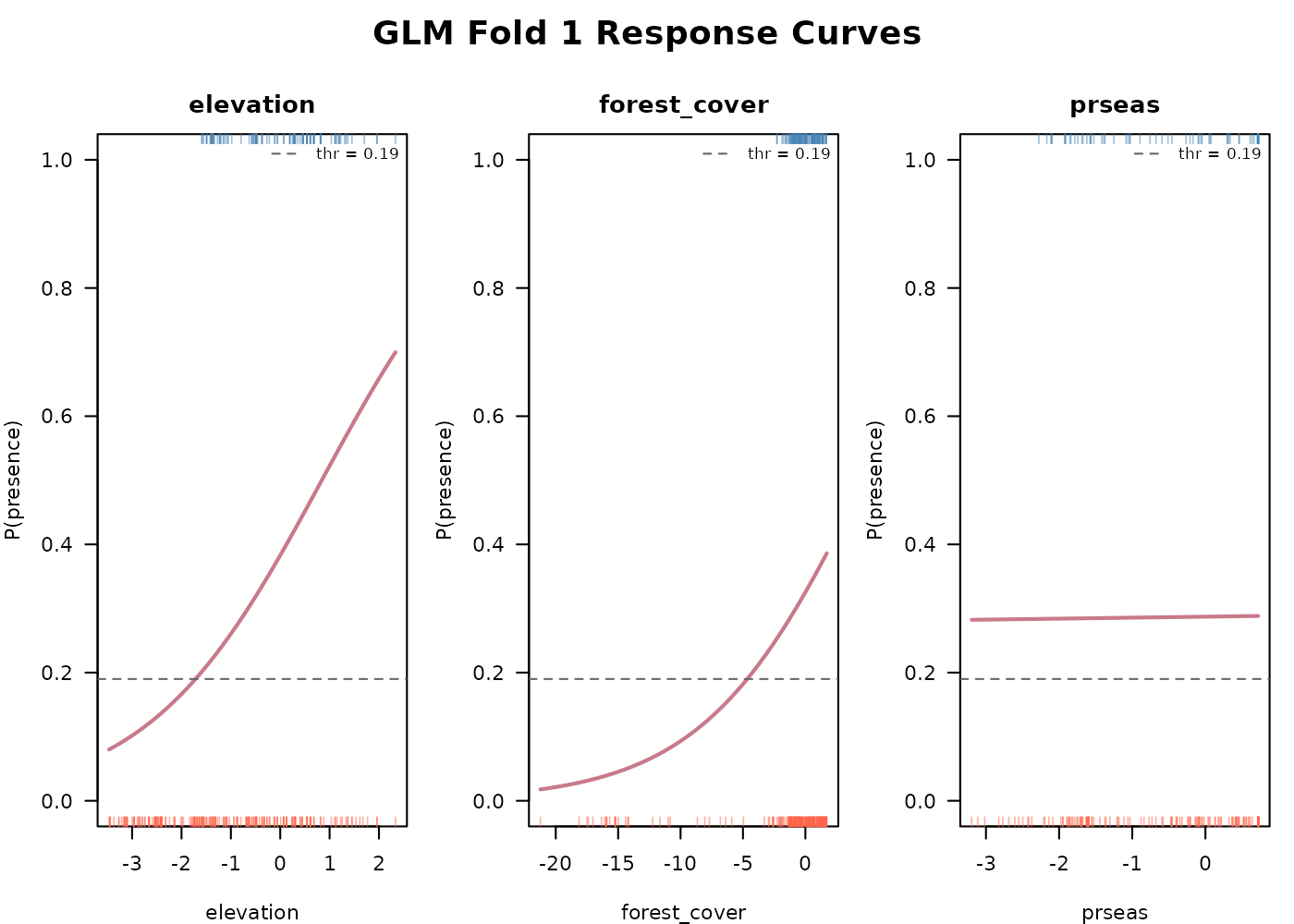
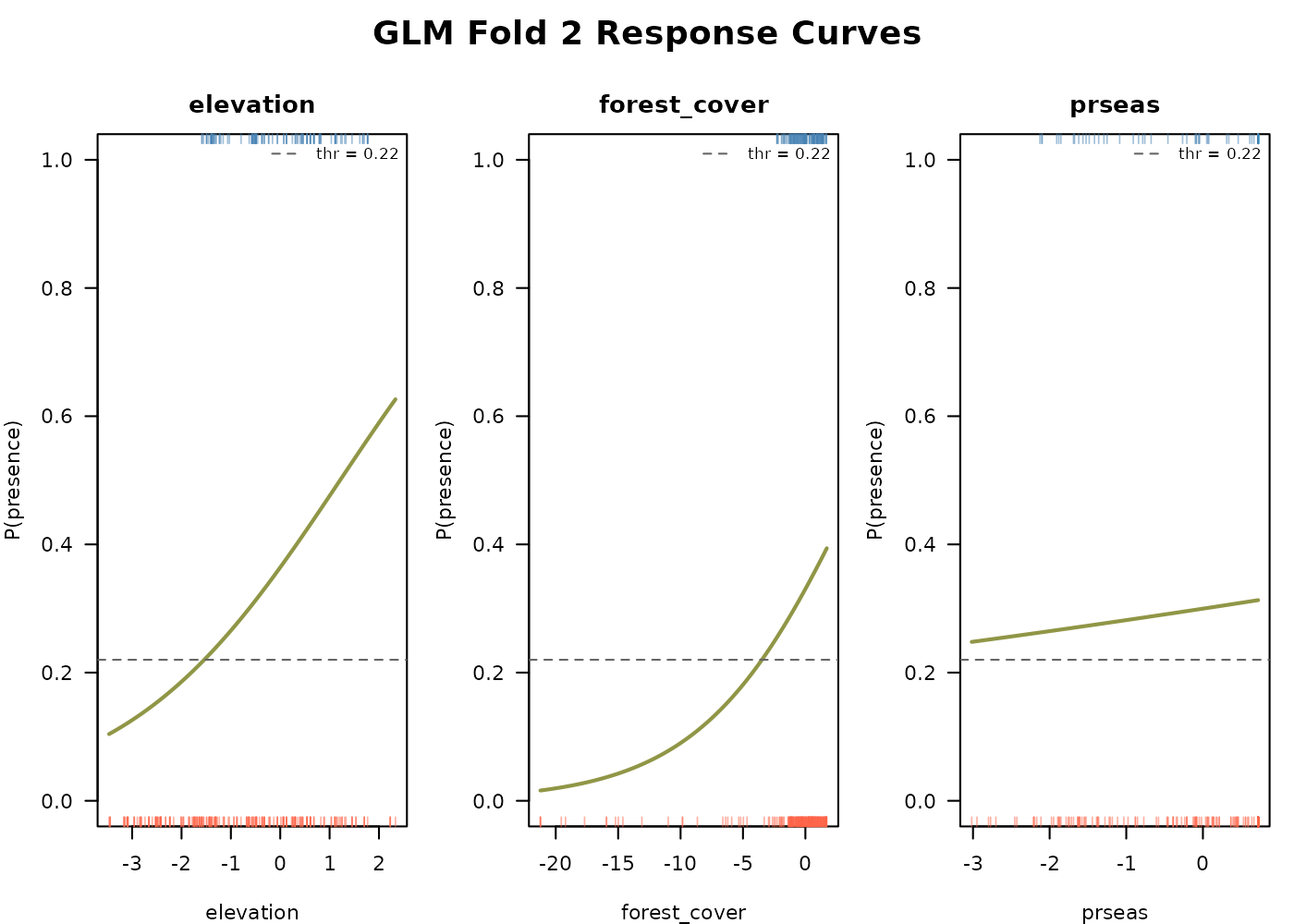
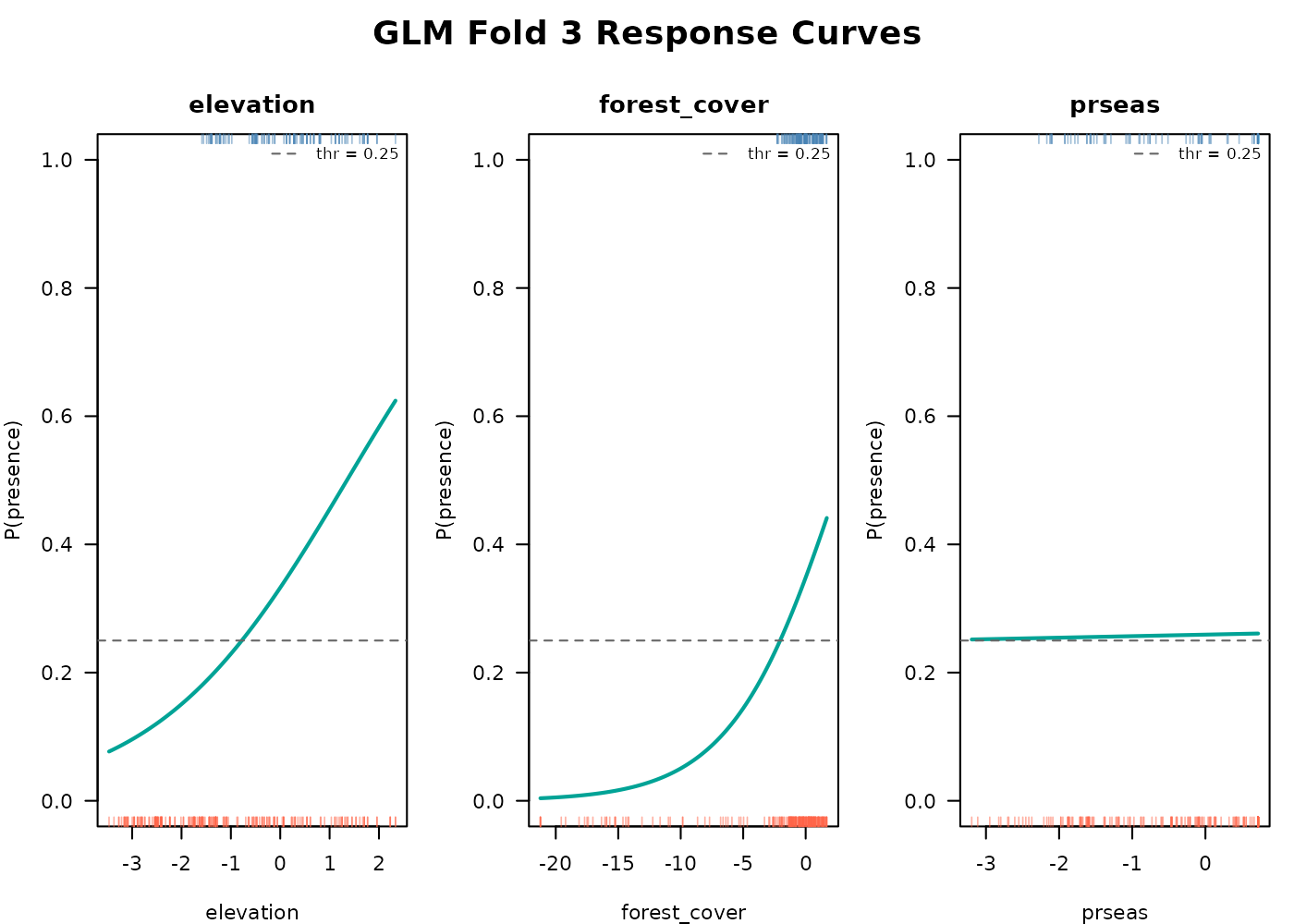
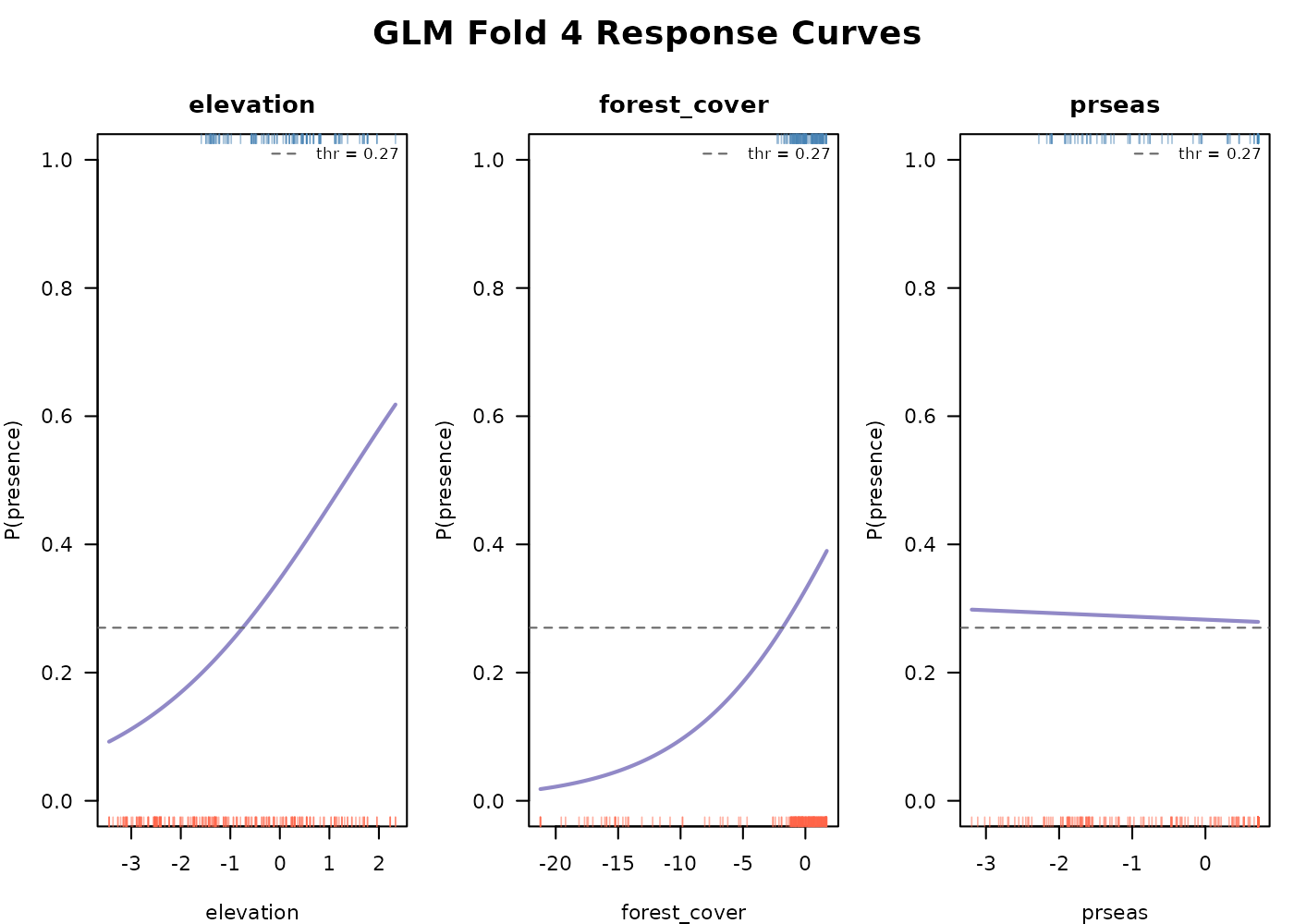
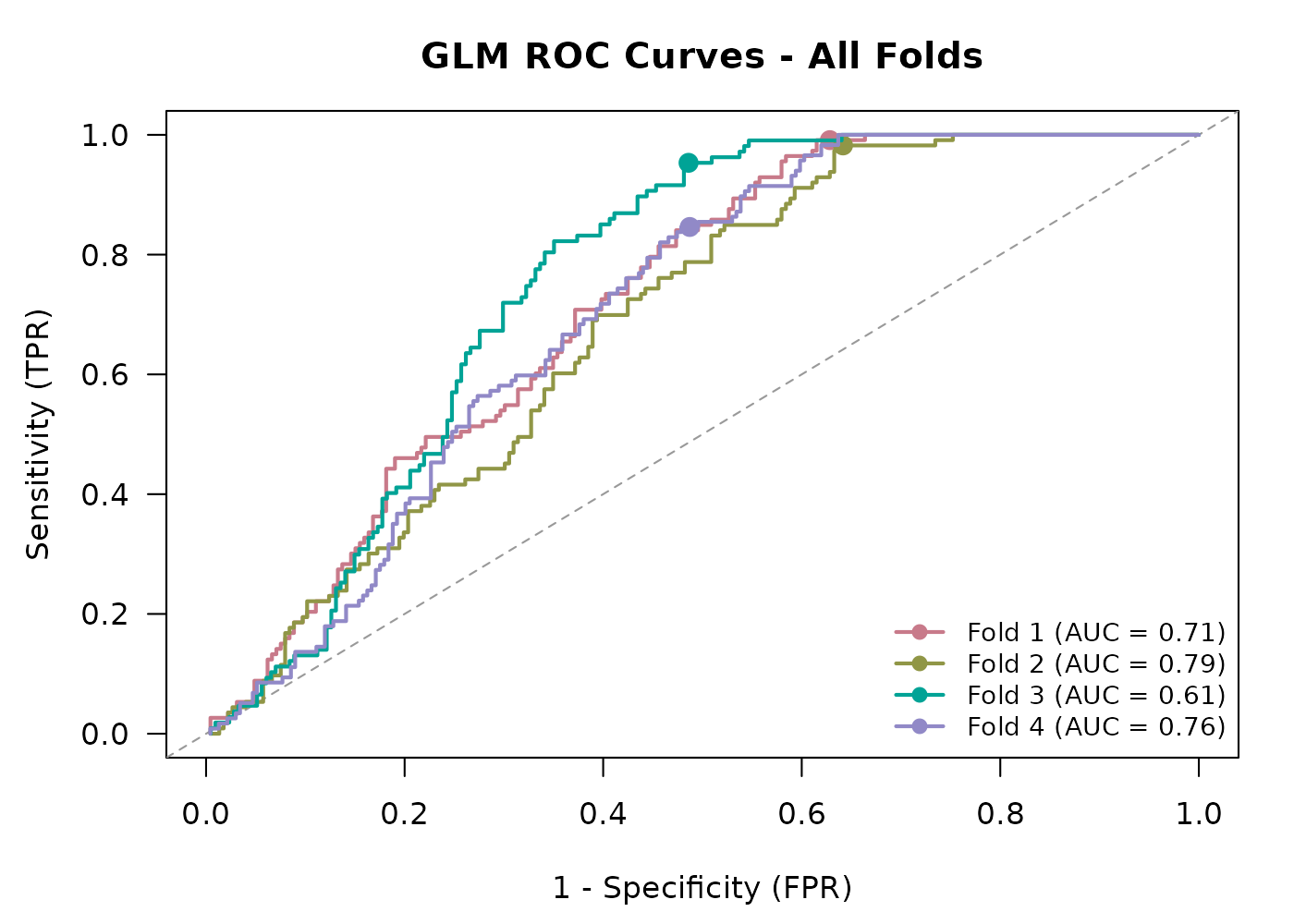
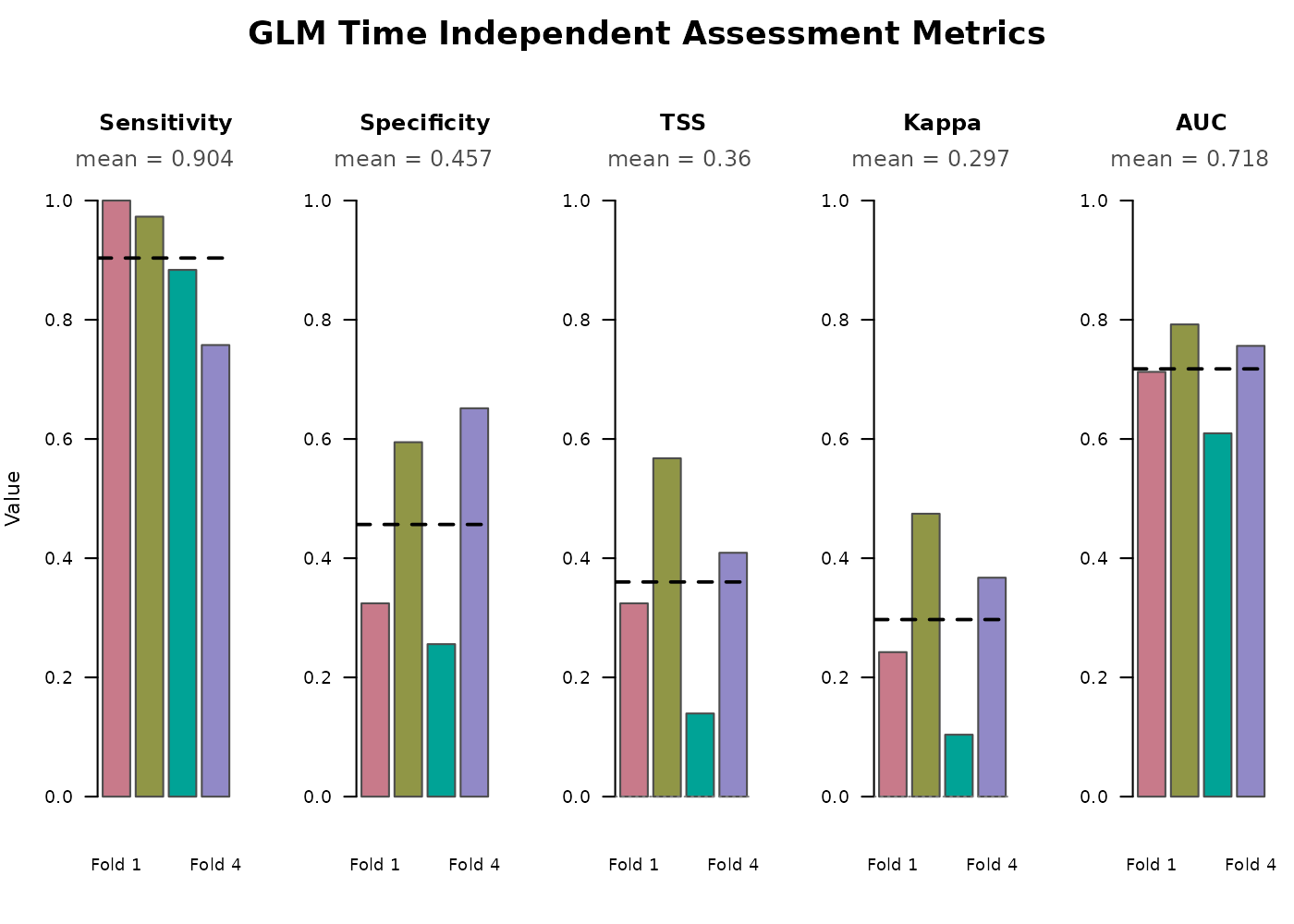
We see that our model correctly identifies a strong positive
relationship between both elevation and forest cover and species
occurrence. The same create_plot = TRUE function also
visualizes time independent model assessment metrics relevant to the GLM
(above). See E-space performance.
class(glm_out)
#> [1] "TemporalGLM" "list"

names(glm_out)
#>  [1] "models"             "thresholds"         "threshold_method"
#>  [4] "model_formula"      "link"               "model_vars"
#>  [7] "fold_training_data" "fold_test_metrics"  "output_dir"
#> [10] "model_type"         "plots"
The returned object is a list of class "TemporalGLM"
containing the following objects:
-
$models- named list ofglmobjects, one per fold (fold1,fold2, …). Each is a standardglmfit and accepts R’s standardsummary(),coef(), andpredict()calls. -
$thresholds- named numeric vector of probability thresholds used to binarize predictions for each fold. -
$threshold_method- character or numeric value recording how the thresholds were chosen ("tss","prevalence", or a fixed numeric value). -
$model_formula- the right hand side formula supplied to the function. -
$link- the link function used ("logit","probit","cloglog", or"cauchit") supplied to the function. -
$model_vars- character vector of the predictor variable names extracted from the formula. Used bygenerate_spatiotemporal_predictions()to know which raster layers to assemble at projection time. -
$fold_training_data- named list of the training data frames used for each fold, with presences and pseudoabsences combined and environmental columns attached. -
$fold_test_metrics- data frame of per-fold E-space metrics computed on the held-out test set. See E-space performance. -
$output_dir- path to the directory where the saved RDS of fitted models and the fold test metrics CSV were written. -
$model_type-"glm", used bygenerate_spatiotemporal_predictions()to choose the correct projection logic. -
$plots- list of recorded base-R plots produced whencreate_plot = TRUE(response curves and the fold metrics bar chart).
Formula syntax
The response variable presence is added automatically to
each formula, so only the right-hand side needs to be supplied. Standard
R formula operators are valid: + for additive terms,
: for interaction only, * for main effects
plus interaction, I() for arithmetic transformations,
poly() for orthogonal polynomials, log(),
sqrt(), and so on. Variable names must match column names
in the data exactly. These examples that all work:
### Additive
~ elevation + forest_cover + prseas

### Quadratic term on elevation
~ elevation + I(elevation^2) + forest_cover + prseas

### Orthogonal polynomial of degree 2 on elevation
~ poly(elevation, 2) + forest_cover + prseas

### Forest cover by precipitation interaction
~ elevation + forest_cover * prseas
If you choose a link other than logit, set it via the
link argument.
Threshold selection
GLMs produce probabilities on the 0–1 scale. The rest of the
TemporalModelR pipeline operates on binary suitability rasters, so a
probability threshold must be chosen to convert probabilities into 0/1
predictions. threshold_method supports three options:
-
"tss"(default) - selects the threshold that maximizes True Skill Statistic (sensitivity + specificity − 1) on the training data. See E-space performance. This balances commission and omission. -
"prevalence"- sets the threshold equal to the prevalence (proportion of presences) in the training data for that fold. - A numeric value between 0 and 1 - used as a fixed threshold for all
folds, e.g.
threshold_method = 0.4.
The chosen thresholds for our four folds:
glm_out$thresholds
#> fold1 fold2 fold3 fold4
#>  0.19  0.22  0.25  0.27
These are per-fold values because each fold trains on a different subset of data and may end up with different probability distributions. Using a single global threshold across folds risks underclassifying suitability in some folds.
E-space performance
Each fold’s held-out test set provides a set of presence and pseudoabsence points the model has never seen based on the folds defined in the Preprocessing temporally explicit data vignette. We compare predicted vs observed at those points and compute confusion-matrix metrics. Because these are evaluated in E-space (the species’ environmental tolerance, independent of geography or time), they give a stable picture of how well the model is preforming.
glm_out$fold_test_metrics
#>   Fold Threshold Testing_TP Testing_FN Testing_TN Testing_FP Sensitivity
#> 1    1      0.19         37          0         24         50      1.0000
#> 2    2      0.22         36          1         44         30      0.9730
#> 3    3      0.25         38          5         22         64      0.8837
#> 4    4      0.27         25          8         43         23      0.7576
#>   Specificity    TSS  Kappa    AUC
#> 1      0.3243 0.3243 0.2424 0.7126
#> 2      0.5946 0.5676 0.4746 0.7922
#> 3      0.2558 0.1395 0.1039 0.6095
#> 4      0.6515 0.4091 0.3673 0.7562
Columns:
-
Fold- fold identifier matching the folds intmr_partition$points_sf$fold. -
Threshold- the per-fold probability threshold used to binarize predictions. -
Testing_TP- count of test-set presence points correctly classified as suitable (true positives). -
Testing_FN- count of test-set presence points incorrectly classified as unsuitable (false negatives). -
Testing_TN- count of test-set pseudoabsence points correctly classified as unsuitable (true negatives). -
Testing_FP- count of test-set pseudoabsence points incorrectly classified as suitable (false positives). -
Sensitivity- proportion of test-set presences correctly classified,Testing_TP / (Testing_TP + Testing_FN). Values close to 1 mean the model rarely misses presences. -
Specificity- proportion of test-set pseudoabsences correctly classified,Testing_TN / (Testing_TN + Testing_FP). Values close to 1 mean the model rarely flags pseudoabsence points as suitable. -
TSS- True Skill Statistic,Sensitivity + Specificity - 1. Ranges from -1 to 1, with 0 indicating performance no better than random and values above ~0.4 considered useful for most applications. -
Kappa- Cohen’s kappa statistic adjusting overall classification accuracy for the accuracy expected by chance. Ranges from -1 to 1 with similar interpretation to TSS. -
AUC- area under the ROC curve, computed on continuous probabilities rather than binarized predictions, so it is threshold-independent. Useful for comparing the models overall performance independent of threshold.
The full ROC curve and each above metric are also graphed as an
output of create_plot = T in the Fitting
a temporal GLM section.
E-space metrics are robust to imbalanced sample sizes across time, because they pool across the time series. They are a good metric for assessing overall model fit. Time-specific (G-space) metrics can also be assessed later when we project the model to specific G-space and time combinations.
Projecting predictions
generate_spatiotemporal_predictions() projects each
fold’s model onto a stack of environmental rasters matching each
requested time step, producing one fold-vote raster per time step. The
same call works for all four model types; model_type in the
model object tells the function which projection logic to use.
For this example we project across all 15 years and 4 seasons, producing 60 prediction layers total, each summarizing votes across the four folds:
scaled_dir <- system.file("extdata/rasters_scaled", package = "TemporalModelR")

time_steps <- expand.grid(
  year             = 1:15,
  season           = c("Spring", "Summer", "Autumn", "Winter"),
  stringsAsFactors = FALSE
)

preds <- generate_spatiotemporal_predictions(
  partition_result     = tmr_partition,
  model_result         = glm_out,
  pseudoabsence_result = tmr_absences,
  raster_dir           = scaled_dir,
  variable_patterns    = c(
    "elevation"    = "elevation",
    "forest_cover" = "forest_cover_YEAR",
    "prseas"       = "prseas_YEAR_SEASON"
  ),
  time_cols            = c("year", "season"),
  time_steps           = time_steps,
  output_dir           = file.path(tempdir(), "GLM_Predictions"),
  overwrite            = TRUE,
  verbose              = FALSE
)
We can now visualize the 60 prediction rasters as a year-by-season grid. Each cell shows the number of folds (0 to 4) that classified that pixel as suitable.
terra::plot() limits each call to 16 layers, so we
render the stack in four blocks of four years each.
pred_stack <- terra::rast(preds$prediction_files)

pred_names    <- basename(preds$prediction_files)
pred_seasons  <- sub(".*_(Spring|Summer|Autumn|Winter)\\.tif$", "\\1", pred_names)
pred_years    <- as.numeric(sub(".*_(\\d+)_(Spring|Summer|Autumn|Winter)\\.tif$",
                                "\\1", pred_names))
season_levels <- c("Spring", "Summer", "Autumn", "Winter")
stack_order   <- order(pred_years, match(pred_seasons, season_levels))

pred_stack <- pred_stack[[stack_order]]
ordered_years   <- pred_years[stack_order]
ordered_seasons <- pred_seasons[stack_order]
names(pred_stack) <- paste0("Y", ordered_years, "_", ordered_seasons)

block1 <- which(ordered_years %in%  1:4)
block2 <- which(ordered_years %in%  5:8)
block3 <- which(ordered_years %in%  9:12)
block4 <- which(ordered_years %in% 13:15)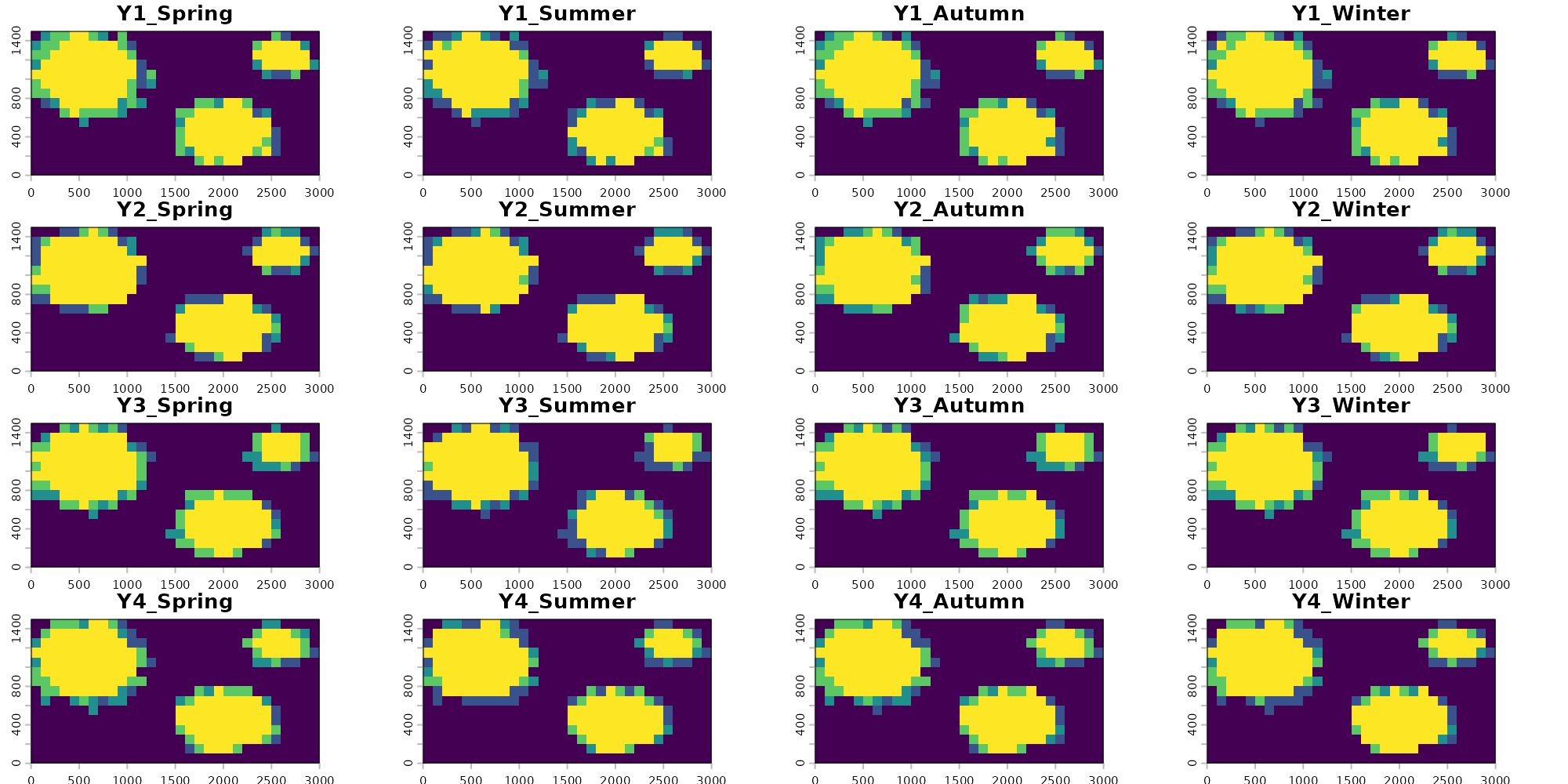
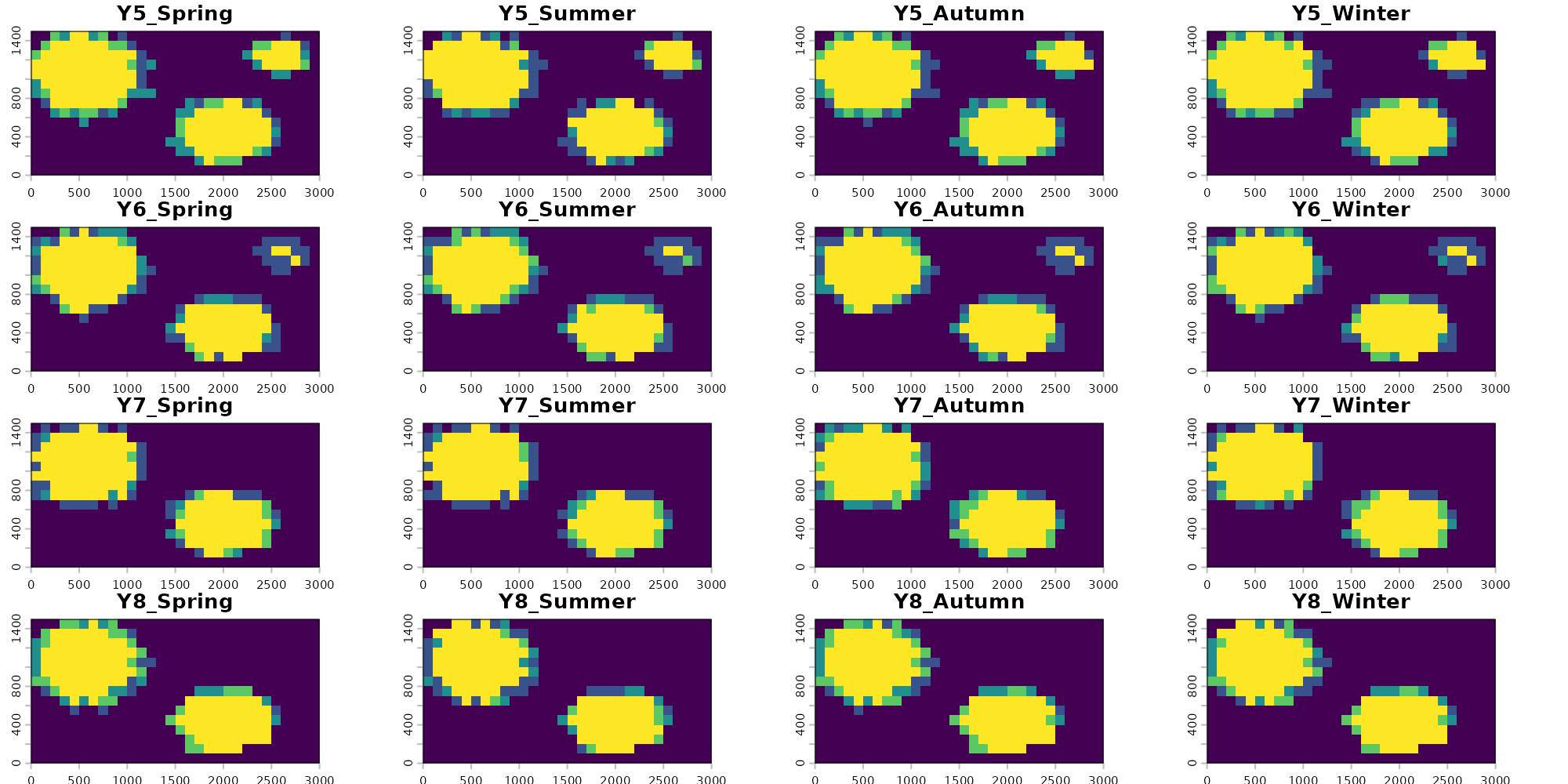
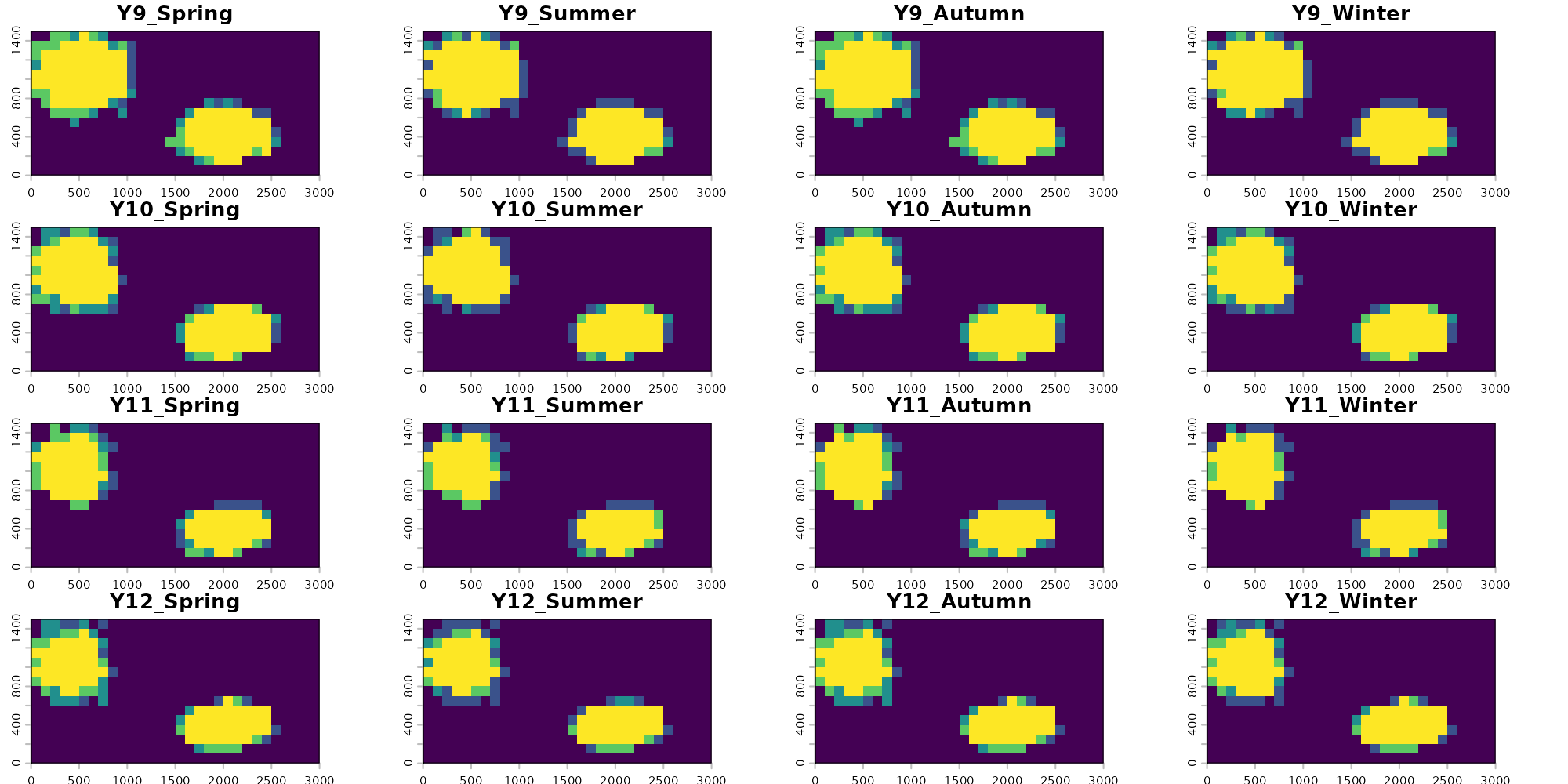
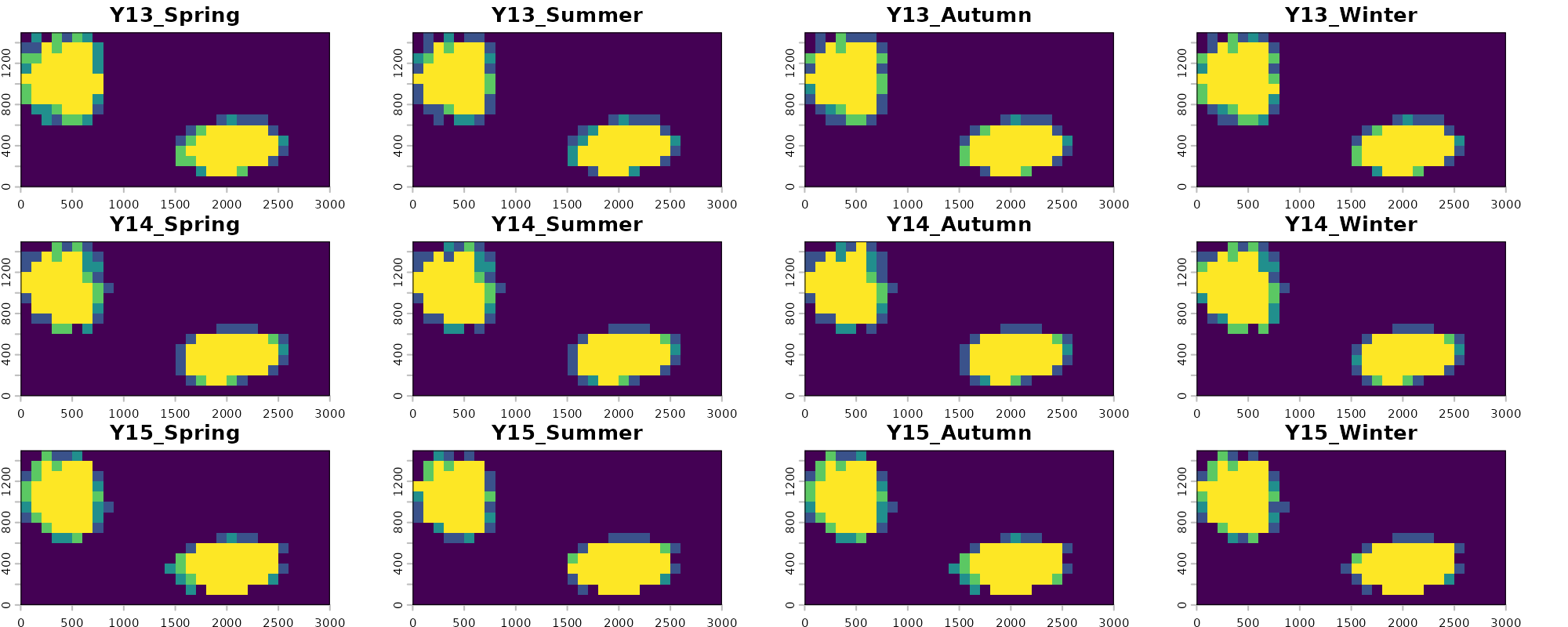
Visualizing our predictions across each season and year, we see that there is generally high agreement among models. These rasters represent consensus votes among each of our four folds, with yellow pixels having strong positive consensus among all folds (all four identify the pixel as suitable) and blue pixels having low consensus among folds (few to no folds identify the given pixel as suitable). We also see that the models correctly visually show one of the main temporal trends in the data: loss of habitat through deforestation starting around year 6.
The GLM here does not pick up on the seasonal variability in precipitation patterns driving activity patterns for this hypothetical species, partially because the model itself is missing the relationship between precipitation and occupancy. This is in part due to the lack of low precipitation value background points in our dataset which would correctly identify the gap here and this methods reliance on that background data to make inference. We can explore if other modeling methods are able to fix this hurdle in other vignettes. Alternatively, we could use an alternative method for generating absence points which we describe more in the the Preprocessing vignette.
Note that here we show that time_steps can handle making
predictions from compound variables or variables at different temporal
scales so long as their temporal scales are nested. For example here
“elevation” has no temporal value and is considered to be static across
all time steps. “forest_cover” is measured annually, but is considered
to be static across all seasons within a year for the purposes of
predictions. “preseason” is measured both by year and season, so
resulting seasonal predictions reflect that. However if precipitation
was only measured based on aggregate seasons but had no associated year,
predictions would fail. Predictions can also be made where all variables
share the same time step- for example annual forest cover, annual
temperature, and annual precipitation.
Additionally, a plain vector like time_steps = 1:15
produces one prediction per value of the first time column; the other
time columns are filled in with every unique value present in the
occurrence data. So a vector input with
time_cols = c("year", "season") would produce one
prediction per year-season combination observed in the data. A data
frame like the expand.grid() above gives explicit control:
any combination of values can be requested, including ones not present
in the occurrence data, as long as the matching rasters exist (Such as
Summer or Winter predictions).
G-space performance
Once predictions are projected, per-time-step metrics become available. These are computed by overlaying the held-out test points (presences plus, optionally, pseudoabsences) on the prediction raster for each time step they fall in and counting correct vs incorrect classifications.
head(preds$timestep_metrics)
#>   Fold Pct_Suitable N_Pres TP FN Sensitivity        CBP N_Abs TN FP Specificity
#> 1    1       0.4156      2  2  0         1.0 0.17268642     4  0  4         0.0
#> 2    2       0.3844      2  2  0         1.0 0.14779753     4  2  2         0.5
#> 3    3       0.3533      5  4  1         0.8 0.05039517    10  1  9         0.1
#> 4    4       0.2667      0 NA NA          NA         NA    NA NA NA          NA
#> 5    1       0.4067      0 NA NA          NA         NA    NA NA NA          NA
#> 6    2       0.3133      2  2  0         1.0 0.09817778     4  2  2         0.5
#>    TSS year season
#> 1  0.0    1 Spring
#> 2  0.5    1 Spring
#> 3 -0.1    1 Spring
#> 4   NA    1 Spring
#> 5   NA    2 Spring
#> 6  0.5    2 Spring
Columns:
-
Fold- fold identifier; one row per fold per time step. -
Pct_Suitable- proportion of the study area predicted suitable in that time step. -
N_Pres- number of held-out presence test points falling in that time step for that fold. -
TP- true positives, presences correctly classified as suitable in that time step. -
FN- false negatives, presences incorrectly classified as unsuitable in that time step. -
Sensitivity-TP / (TP + FN)for that fold-time step. -
CBP- cumulative binomial probability. Under the null that each test point lands in suitable area at the ratePct_Suitable, this is the probability of observing exactlyTPcorrectly classified points by chance. Small values indicate predictions are better than random. -
N_Abs- number of held-out pseudoabsence test points falling in that time step.NAfor presence-only models. -
TN- true negatives, pseudoabsences correctly classified as unsuitable. -
FP- false positives, pseudoabsences incorrectly classified as suitable. -
Specificity-TN / (TN + FP)for that fold-time step. -
TSS-Sensitivity + Specificity - 1for that fold-time step. -
yearandseason- the values oftime_colsfor that row, identifying which time step the metrics belong to.
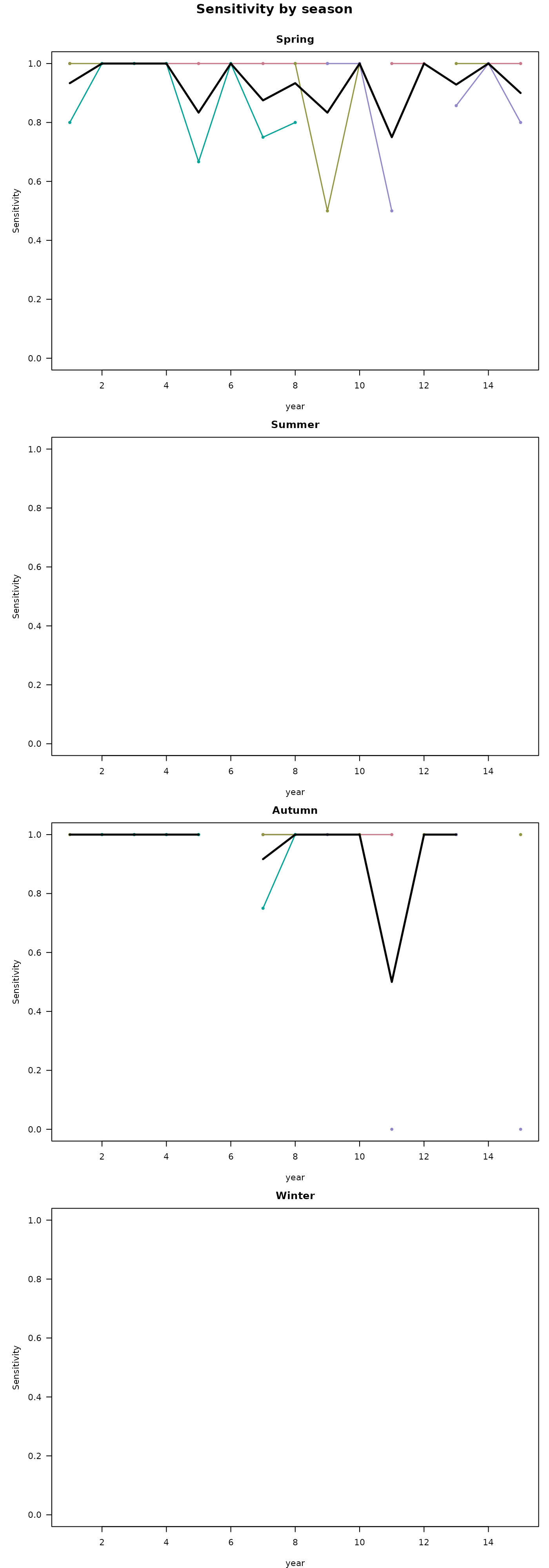
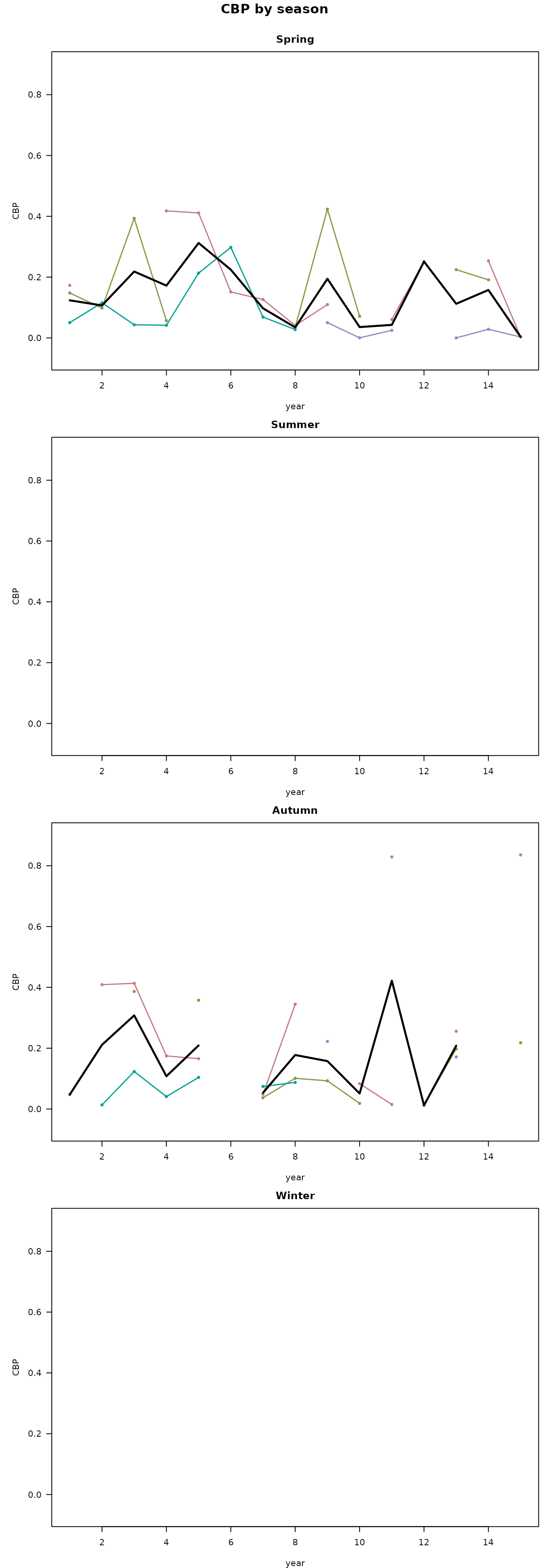
G-space metrics are powerful in time steps with substantial sample
sizes but lose meaning when few records exist (as with out example). A
fold with only one presence in a given year can score sensitivity 0 or 1
with no real information content. Likewise, the ability to earn a
significant G-space CBP score explicitly depends on sample size. Report
E-space (from $fold_test_metrics) and G-space (from
$timestep_metrics) together for a complete view of model
performance.
The overall summary gives a per-fold summary across all time steps:
preds$overall_summary
#>   Fold N_Timesteps Mean_Pct_Suitable Total_TP Total_FN Overall_Sensitivity
#> 1    1          60            0.3336       37        0              1.0000
#> 2    2          60            0.2686       36        1              0.9730
#> 3    3          60            0.2673       38        5              0.8837
#> 4    4          60            0.2303       25        8              0.7576
#>    Overall_CBP Total_TN Total_FP Overall_Specificity Overall_TSS
#> 1 2.275703e-18       24       50              0.3243      0.3243
#> 2 7.575386e-20       44       30              0.5946      0.5676
#> 3 3.420081e-17       22       64              0.2558      0.1395
#> 4 1.958217e-10       43       23              0.6515      0.4091
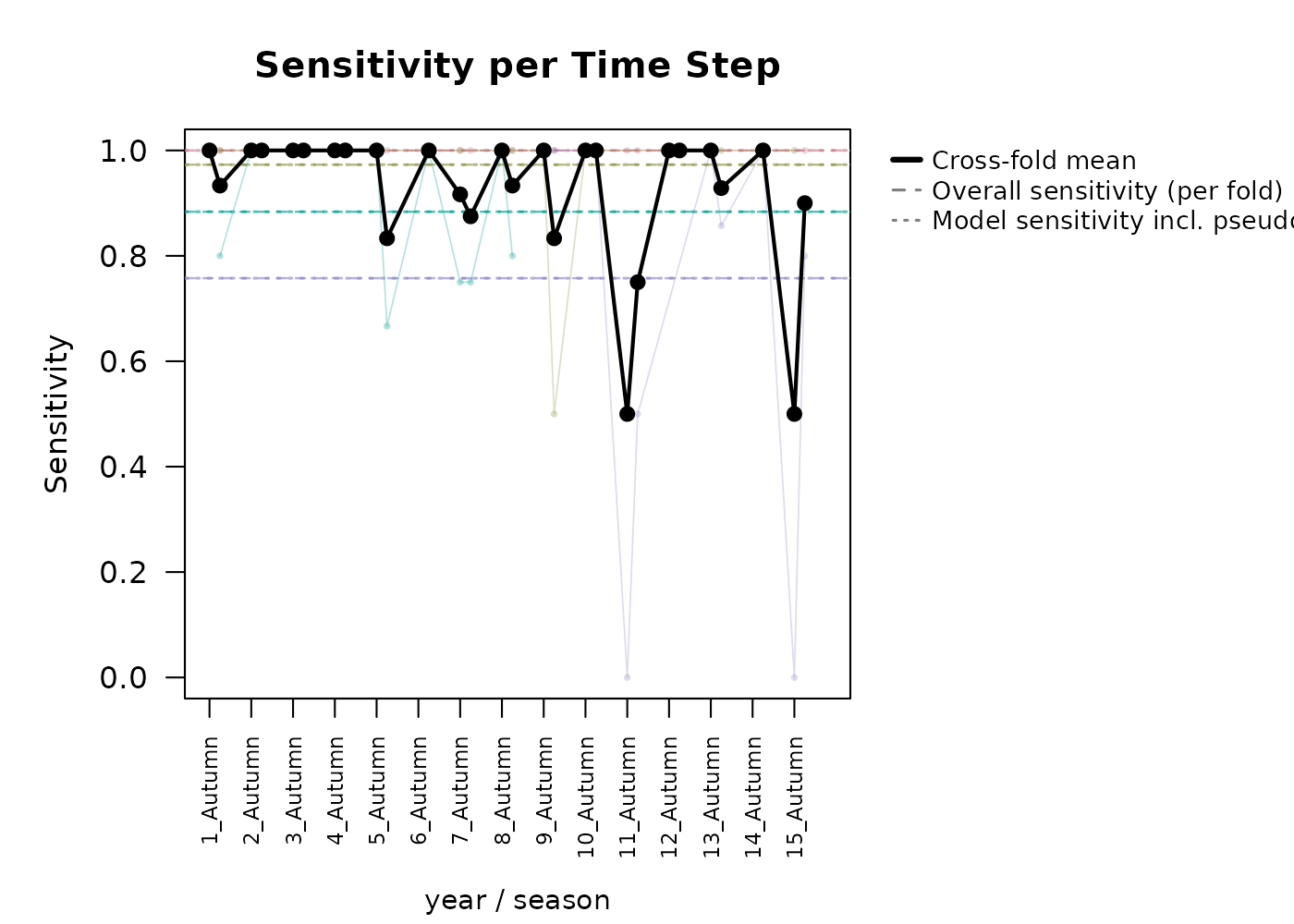
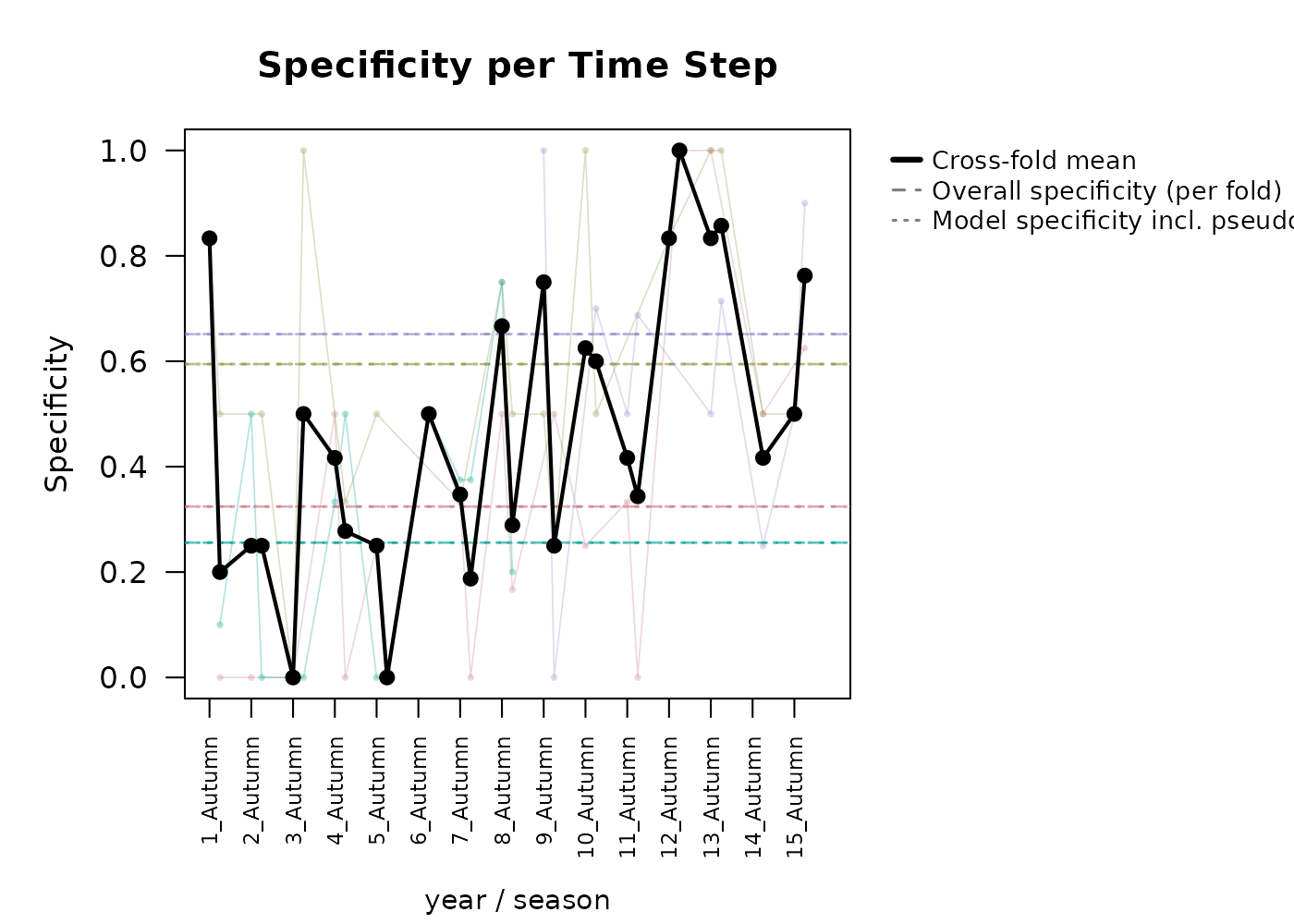
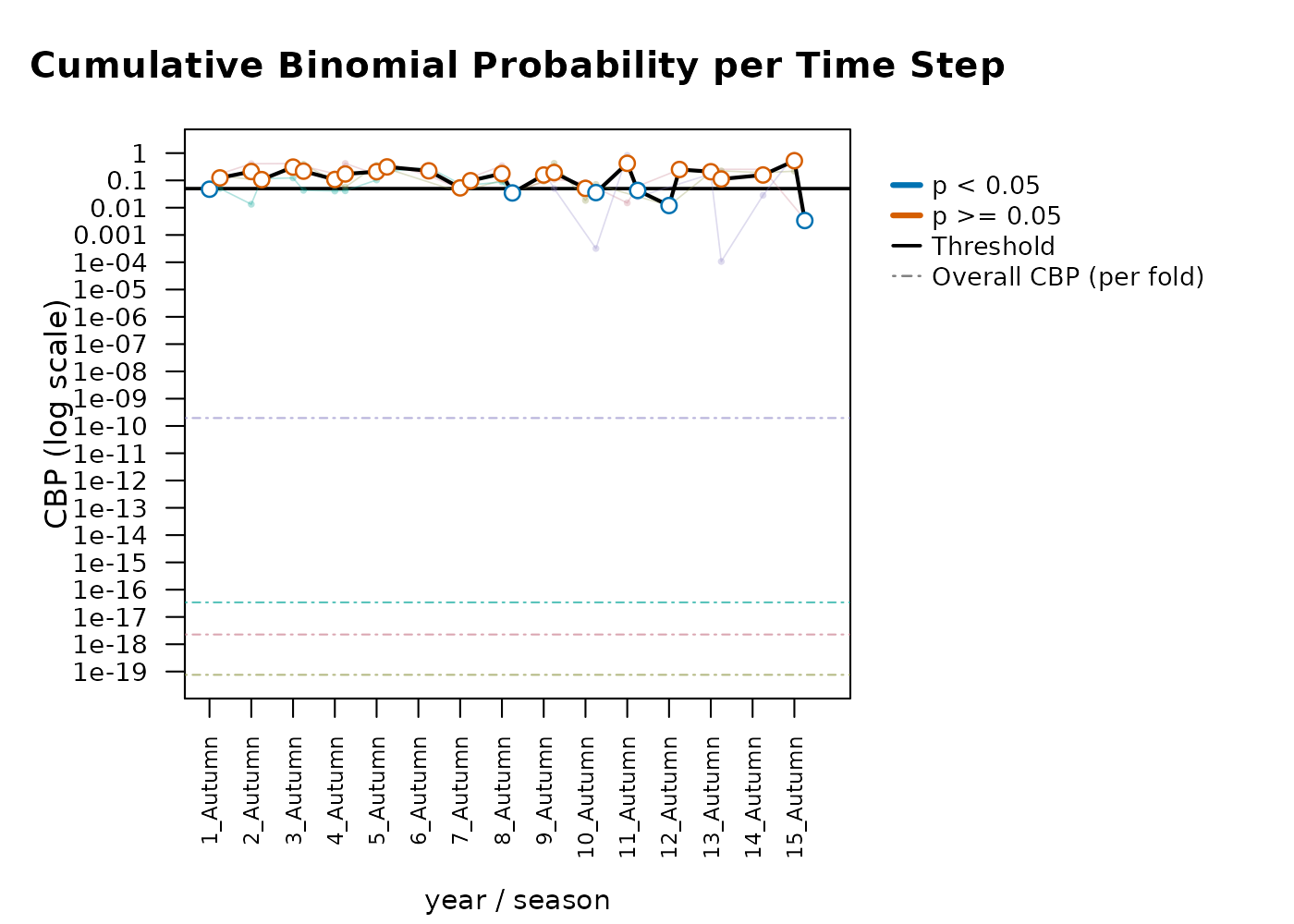
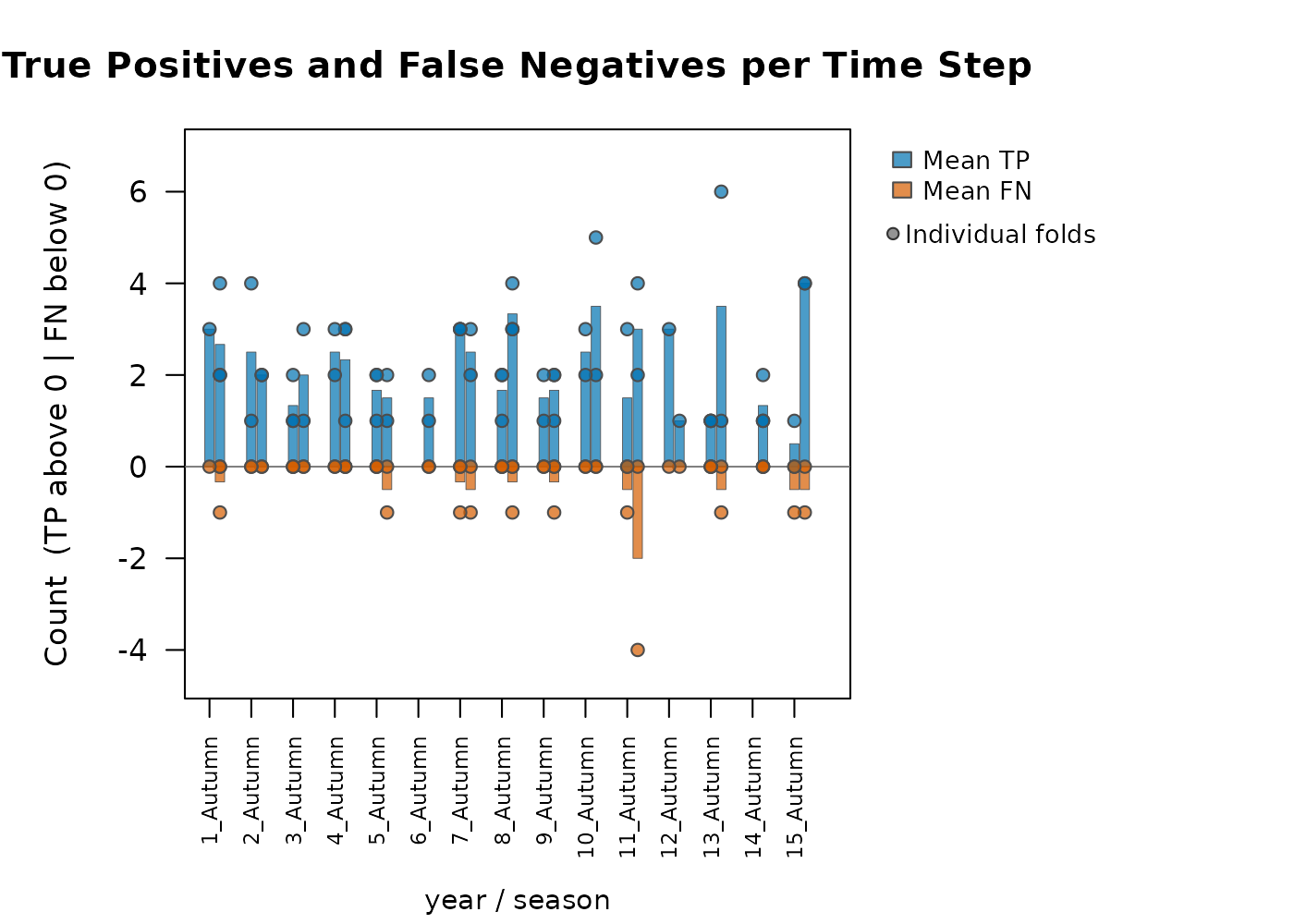
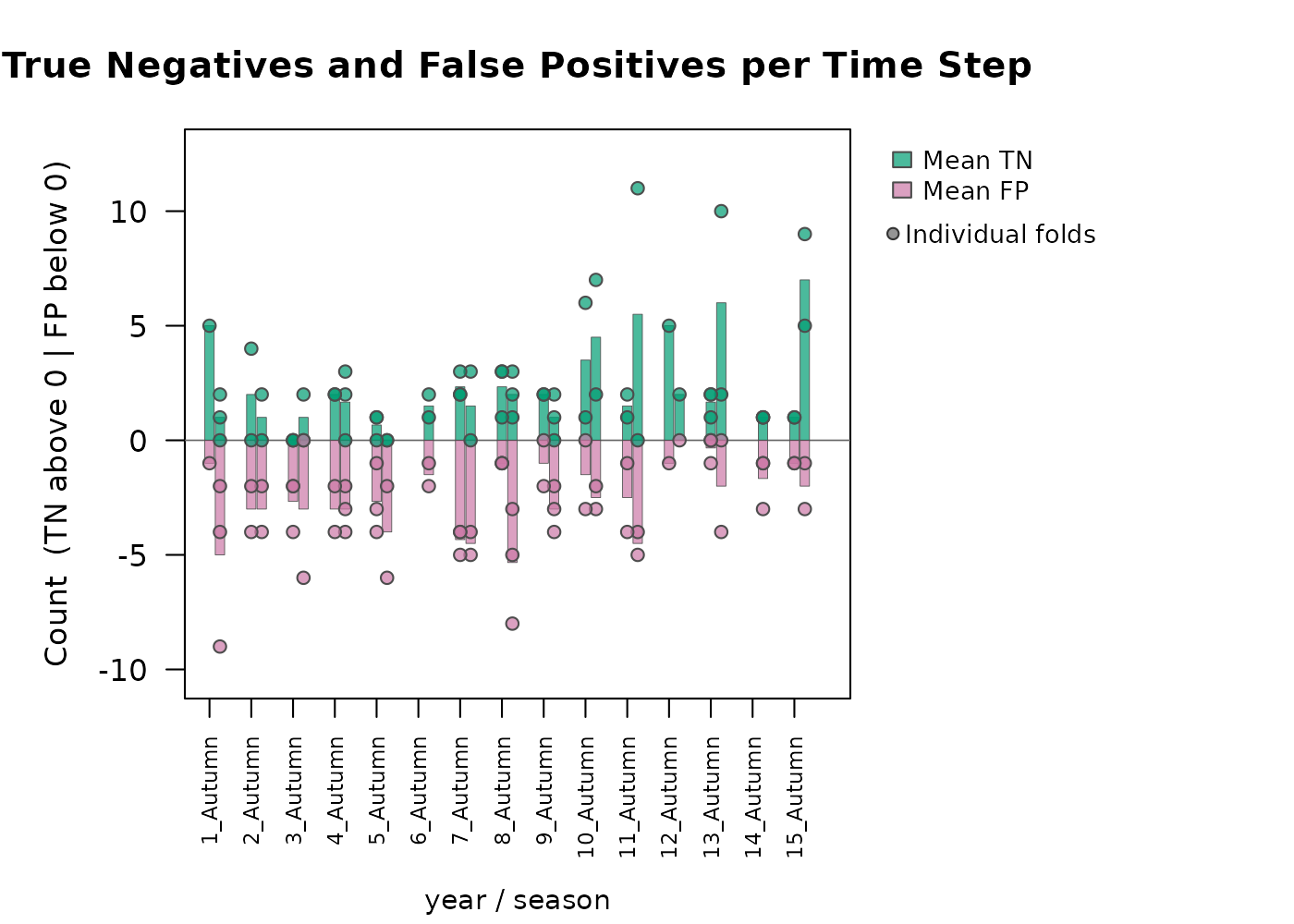
Rapid visual assessment of these metrics can be done using the
function plot_model_assessment() which generates simple
summary plots for each.
plot_model_assessment(
  predictions         = preds,
  time_column         = c("year", "season"),
  secondary_time_mode = "combine",
  model_result        = glm_out
)
#> Loaded fold_test_metrics for 4 fold(s).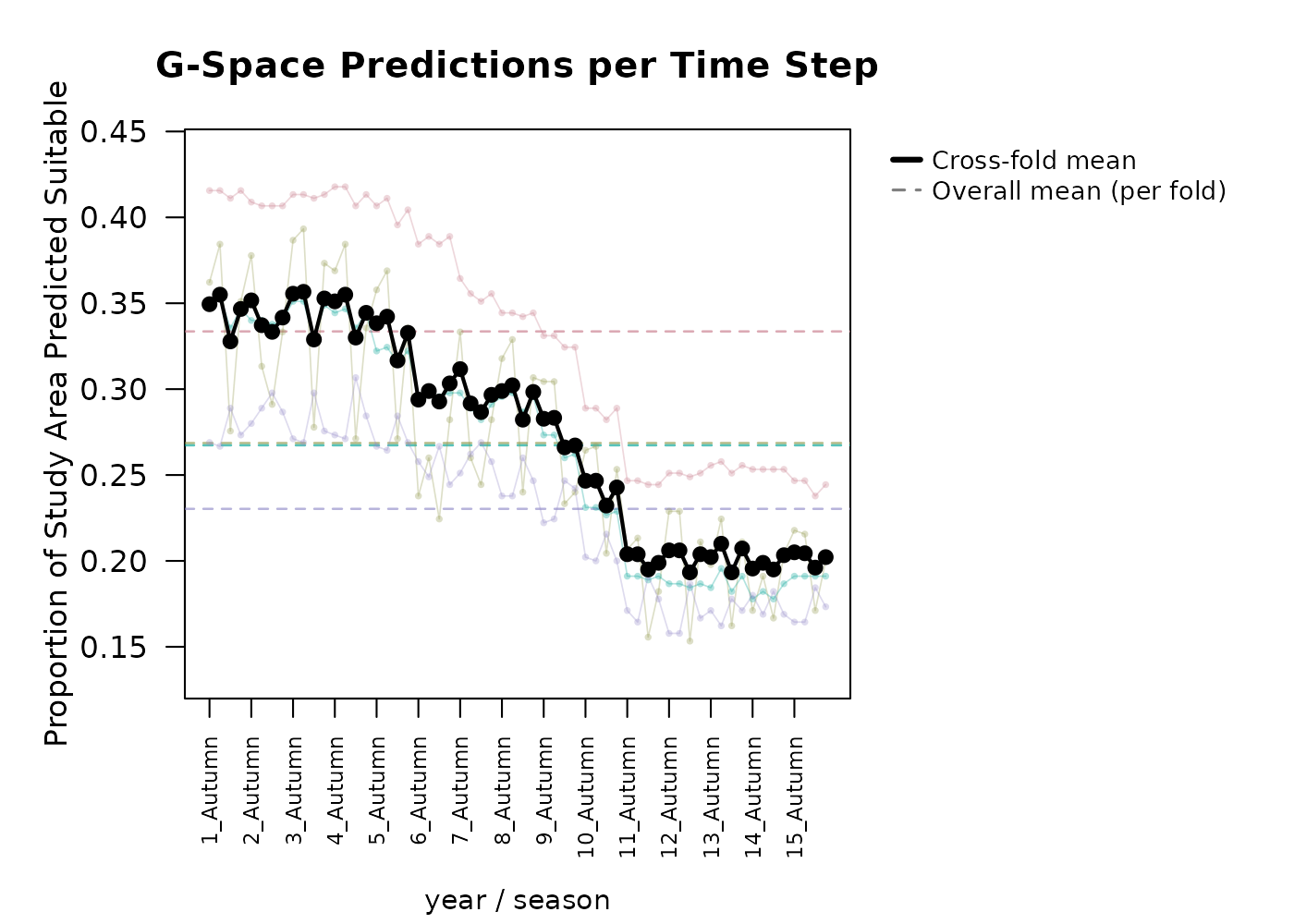
#>          Metric    Mean     SD
#>    Pct_Suitable  0.2749 0.0731
#>     Sensitivity  0.9274 0.2026
#>     Specificity  0.4314 0.3207
#>  CBP < 0.05 (%) 30.2000     NA
This produces per-fold time series of percent suitable, sensitivity,
specificity, CBP, TP/FN, and TN/FP. When model_result is
also supplied, overall sensitivity and specificity from
$fold_test_metrics are added as reference lines. When
compound time steps are used (such as year and season), you must choose
how they are visualized. Choosing
secondary_time_mode = "combine" will roll them into one
continuous x axis. secondary_time_mode = "facet" produces
stacked plots as seen below, where the first time_col is
displayed as the x axis, and a different plot is made for each secondary
variable (season here). By default, the threshold for which
CBP is identified as significant is 0.05, but this may also be adjusted
manually.
plot_model_assessment(
  predictions         = preds,
  time_column         = c("year", "season"),
  secondary_time_mode = "facet",
  model_result        = glm_out,
  cbp_threshold       = 0.001
)
#> Loaded fold_test_metrics for 4 fold(s).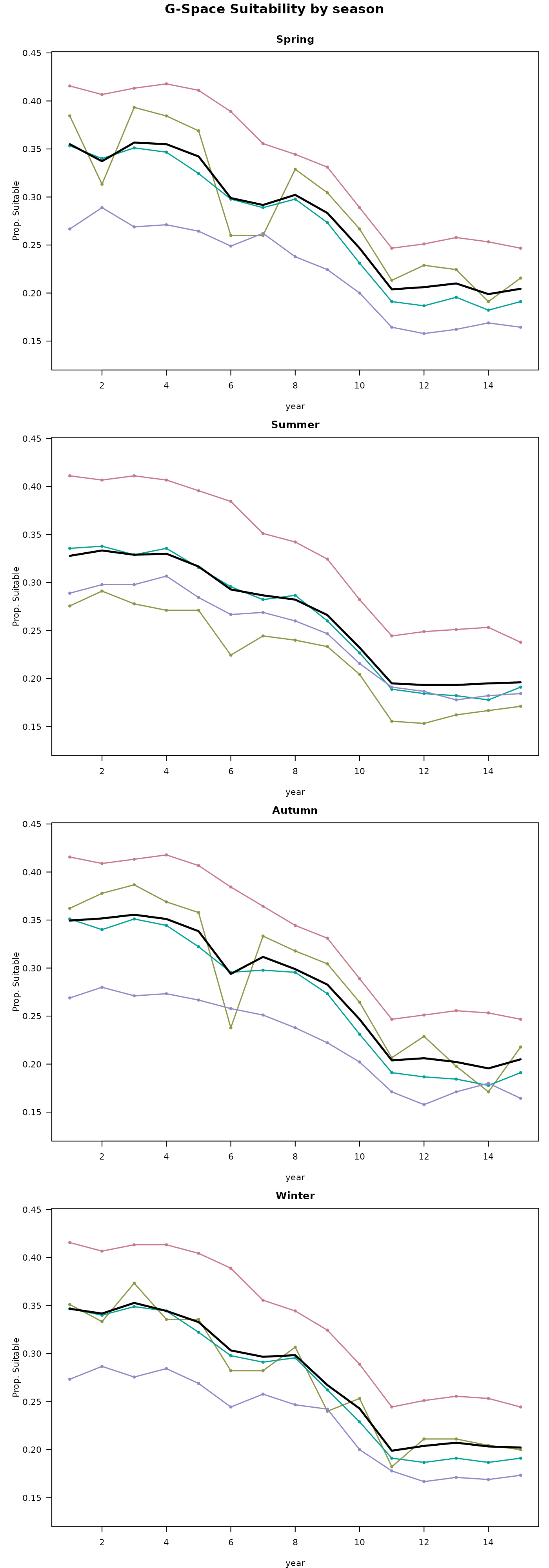

#> Facet mode: produced 4 stacked plot(s) across 4 season value(s).Next steps
Now that predictions have been generated, you can assess the model and see if it is preforming satisfactory enough for what your goals are. If this is the case, you can preform post-processing analyses to try to gain additional inference about the spatiotemporal patterns of change in the study region See the Post-processing predictions vignette.
For comparison with other algorithms applied to the same dataset:
- Modeling with a GAM - smooth nonlinear responses.
- Modeling with a Random Forest - flexible ensemble of decision trees for complicated relationships to variables.
- Modeling with a Hypervolume - presence-only modeling using n-dimensional kernel density or one-class SVM.